
| Check | Main question | What it tells you |
| 1 | Does PlayDash serve your country? | Whether it is an operator target market |
| 2 | Is your country restricted? | Whether registration is refused |
| 3 | What does the licence cover? | The operator’s regulatory framework |
| 4 | Do KYC and market lists match? | Whether verification data is being misread as availability |
Check One: Is Your Country One the Operator Serves?
The first check is commercial rather than legal. PlayDash decides which markets it actively serves and can maintain country-specific portals, currencies, payment options and account conditions for them.
Current PlayDash public material identifies Malaysia alongside dedicated regional operations for Singapore and Thailand. The operator’s portal also presents separate verified links and market-specific landing pages.
The Markets on the Accepted Side
The core markets identified in current PlayDash material are:
- Malaysia;
- Singapore;
- Thailand.
For this page, Malaysia is the relevant market. PlayDash-facing Malaysian resources use MY-specific content and account information, so Malaysia is clearly part of the operator’s intended regional footprint.
That does not mean the existence of a Malaysian PlayDash site amounts to a statement that online gambling is legally permitted for every person in Malaysia. Operator availability and local legality answer different questions.
A market can therefore pass the first check and still require the reader to consider local law and personal eligibility separately.
Check Two: Does the Operator Reject Your Country?
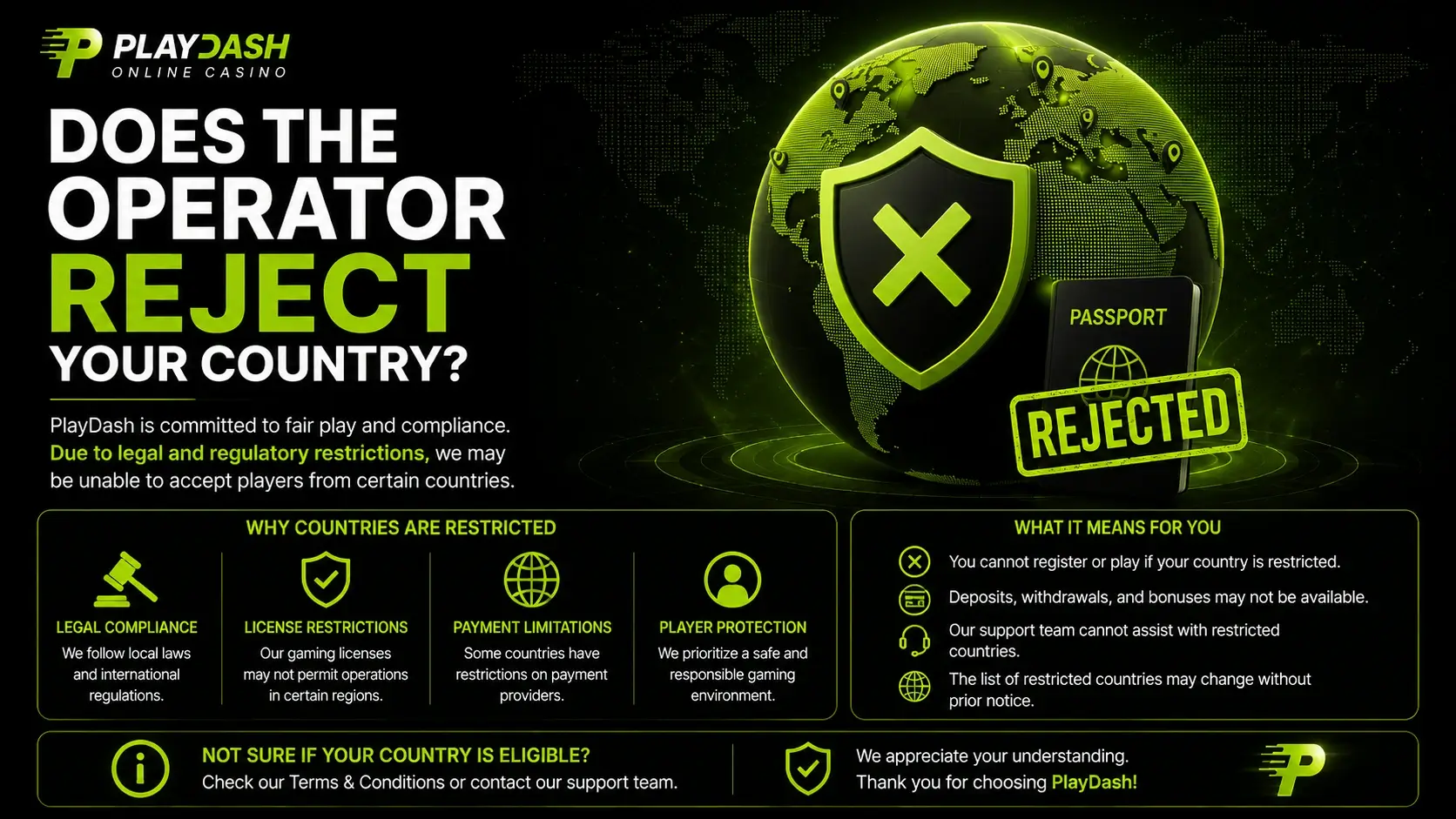
The second check goes in the opposite direction. Some jurisdictions are excluded even if a PlayDash page can technically be reached from there.
Current PlayDash restriction information identifies the following locations as unavailable for registration:
- England;
- Scotland;
- Wales;
- Northern Ireland;
- Russia;
- India;
- United States.
The four UK nations above collectively fall within the United Kingdom, which is also among the territories excluded under the wider Anjouan licensing framework. The United States is likewise excluded by the Anjouan framework.
Where Sign-Ups Are Refused Outright
A useful way to read these lists is to separate operator targeting from exclusion.
| Market position | Countries currently relevant to this comparison |
| Actively served PlayDash markets | Malaysia, Singapore, Thailand |
| Restricted PlayDash registrations | England, Scotland, Wales, Northern Ireland, Russia, India, United States |
| Licence-level excluded example | United Kingdom, United States |
| Other countries | Require current operator and local-law checks |
Country restrictions can change, so an old availability table should not be treated as permanent. The current operator position matters most when someone is actually considering registration.
It is also important not to reverse the logic: a country missing from the restricted list is not automatically confirmed as a fully supported PlayDash market.
Check Three: Does the Licence Change Anything for You?
PlayDash is operated under an Anjouan gaming licence associated with Overtensis Limitada. Current licence-monitoring data lists ALSI-202410062-FI2 as active and connects PlayDash domains including playdash.io, playdash.net and playdash66.com with the licensed operator.
That licence is relevant when assessing the operator. It does not replace national law where the player lives.
What an Offshore Permit Does Not Grant
An offshore licence establishes the regulatory framework under which the operator conducts gambling activity. It can identify the licence holder, permitted domains and regulator responsible for the licence.
It does not provide a Malaysian player with a personal exemption from Malaysian law.
The distinction looks like this:
| Anjouan licence | Local law |
| Regulates the licensed operator | Applies in the player’s jurisdiction |
| Identifies the licence holder | Determines local restrictions |
| Sets a framework for gambling operations | Is not replaced by an offshore licence |
| Can exclude certain territories | May impose additional local limitations |
PlayDash holding ALSI-202410062-FI2 therefore answers the question “under what offshore framework does this operator work?” It does not answer “am I legally entitled to gamble from my current location?”
Readers remain responsible for considering the rules applying where they are physically located.
Check Four: Are You Confusing Availability With the AML List?
KYC and AML information can create another source of confusion.
A gambling operator may maintain identity, country and risk data covering many more jurisdictions than the small number of countries it actively targets. Those systems exist to verify customers and manage financial crime risk, not to advertise where registration is available.
Two Lists That Do Not Line Up
The two lists serve completely different functions:
- Market list: where PlayDash actively provides or targets its service.
- Restricted list: where accounts are not accepted.
- KYC/AML country data: information used to verify identity, residence and financial risk.
- Licence exclusions: jurisdictions outside the scope permitted by the licensing framework.
A country appearing during a verification process does not prove that PlayDash accepts players there.
KYC may need to process a passport nationality, residential address or payment origin even when that country is not a regular PlayDash market. AML systems can be broader still because they need to recognise sanctioned jurisdictions, high-risk locations and unusual transaction patterns.
For that reason, the presence of a country in an identity-document menu or AML database should never be used as a substitute for an actual availability check.
A Note on Travel and Location Tricks
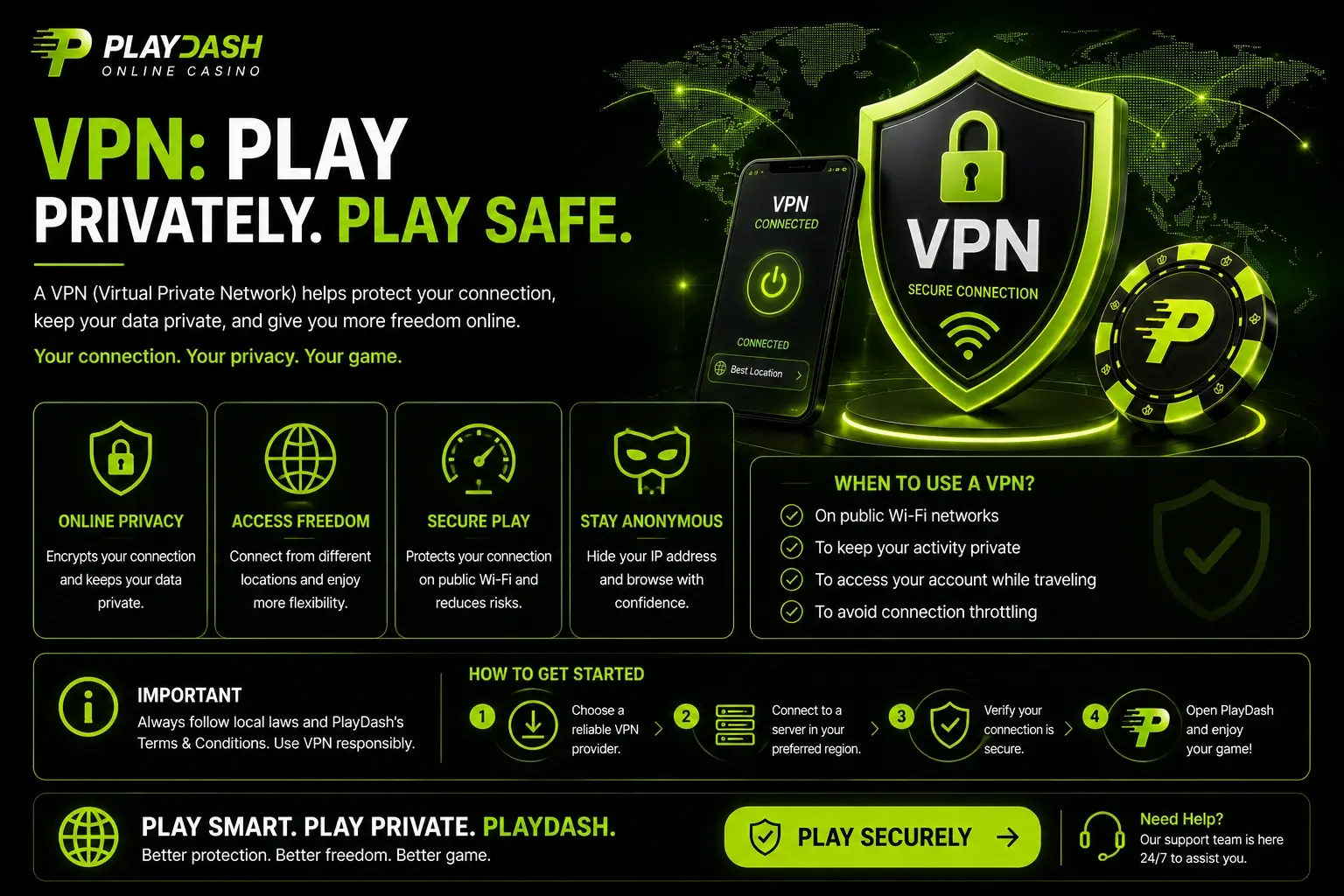
Travel creates a more complicated situation because three facts can temporarily differ: where an account was registered, where the player normally lives and where the current internet connection originates.
Simply travelling does not automatically rewrite the underlying account information.
VPNs, Moving Abroad, and Verification Risk
The important issue is not the mere existence of VPN software. Public PlayDash material has previously discussed tools such as WARP for connectivity, so it would be inaccurate to claim that every use of a VPN is automatically prohibited.
The real risk begins when technology is used to pretend that the player lives in an eligible country or to provide false location information.
Problems can arise when:
- the country entered during registration is false;
- the residential address cannot be supported by documents;
- an ID shows details inconsistent with the account;
- a payment method belongs to a different person or jurisdiction;
- location details supplied during verification conflict with earlier information;
- a player attempts to register from a country PlayDash does not accept.
PlayDash KYC and account controls can require identity and address information to be checked before certain transactions are completed. False or inconsistent information can therefore become particularly important during verification or withdrawal review.
The consequence is not that a VPN magically “freezes money.” Rather, an account based on false residency information can face additional verification, restriction or a withdrawal hold while the operator determines whether the account complies with its rules.
Moving abroad creates a similar issue. A valid Malaysian account does not necessarily remain eligible under exactly the same conditions after the account holder permanently relocates to another jurisdiction.
Putting the Four Checks Together
Access is not decided by a single green light. The relevant factors need to agree with one another.
Before treating PlayDash as available, check:
- whether PlayDash actively serves the country;
- whether that jurisdiction appears among operator restrictions;
- what local gambling law permits;
- whether the Anjouan licence applies to the operator but excludes the jurisdiction;
- whether genuine identity and residential information can pass KYC;
- whether locally appropriate payment infrastructure is available.
For readers in Malaysia, the first check is straightforward: Malaysia is an active PlayDash market. That still leaves the legal, verification and account-eligibility layers.
A site opening in the browser is not enough. Neither is an offshore licence, a country appearing in KYC, or an IP address that appears to come from somewhere else.
The clearest test is whether the operator serves the genuine location, the jurisdiction is not restricted, local rules have been considered, and the account details can survive verification without changing the facts about who and where the player actually is.